







Key Insights from Buffalo Business First’s HR Panel, Featuring Lawley’s Brian Murphy
Navigating today’s dynamic workplace requires thoughtful strategies, proactive management, and a commitment to employee wellbeing.
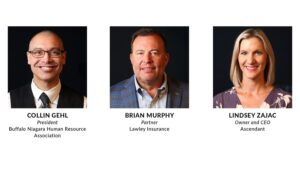
Recently, our very own Brian Murphy, Partner, joined fellow experts Collin Gehl, and Lindsey Zajac in a panel led by Buffalo Business First.
Together, they took a deep dive into rising healthcare costs, generational shifts, and evolving expectations for pay, benefits, and company culture.
Read some key insights below and click here to read the full article.
Rising Costs & Health Plans
Rising health insurance costs are a significant concern for small employers, especially those with fewer than 100 employees, with increases expected to continue into 2026. Managing these costs effectively requires strategic approaches that balance expense reduction with improving health outcomes.
“What employers have to do is understand what their options are and determine what type of path they want to go down from a risk perspective and from an employee disruption perspective, because the costs are just escalating,” Murphy said. “That’s the future of managing these costs.”
Generational Shift
As baby boomers retire rapidly over the next five years, millennials and Generation Z will dominate the workforce, bringing new expectations and challenges for employers. These younger workers seek more support, flexibility, and a voice in their roles, while also requiring guidance on professional skills and realistic salary expectations.
Pay & Benefits
Younger workers today are confident and prioritize pay, benefits, and flexible work hours that reflect their perceived value, yet they require support in developing interpersonal skills and consistent leadership engagement. They expect to have a voice in the workplace, reflecting their upbringing, and understand that salary progression is tied to experience.
Attracting Talent
Effective hiring focuses on assessing intangible skills such as emotional intelligence and cultural fit, which are harder to teach than technical abilities. Employers observe candidates’ behaviors during the recruitment process to predict their future workplace conduct and alignment with company values. The main aspects to evaluate with a candidate are to assess intangible skills, observe candidate behavior, and evaluate overall cultural fit.
Company Culture
Company culture expresses the values and the mission of an organization. It determines the environment and the behaviors that are accepted or rejected. It can also influence the success of the business.
Brian shared how here at Lawley our values of Relationship building, Respect and integrity, Passion, Accountability, Commitment to our community fostered an environment where employees feel connected both in-person and remotely. Efforts to maintain this culture include organizing enjoyable social events and forming a culture committee to address challenges posed by the shift to remote work during the pandemic, ensuring all staff members feel included regardless of location.
“The world has changed, and so now we have events that fit different employees where they are,” Murphy said. “We have to work hard to make sure that we make them feel included,” which extends to remote workers as far away as Kansas and Wisconsin. “When you go to work you know we’re all in this together,”
At Lawley, we’re here to be your strategic partner in assessing the benefits program that best fits the needs of your organization. From developing customized healthcare programs to helping you understand and execute compliance audits and claims management, our team of consultants can act as your Human Resources department, or as a partner to your current HR team. We have experts in your business category, so our team understands the nuances of how you do business, what your employees really need, and how to reduce risks and costs to your bottom line. Visit this page to learn more and get in touch with our team.